
July 22, 2026
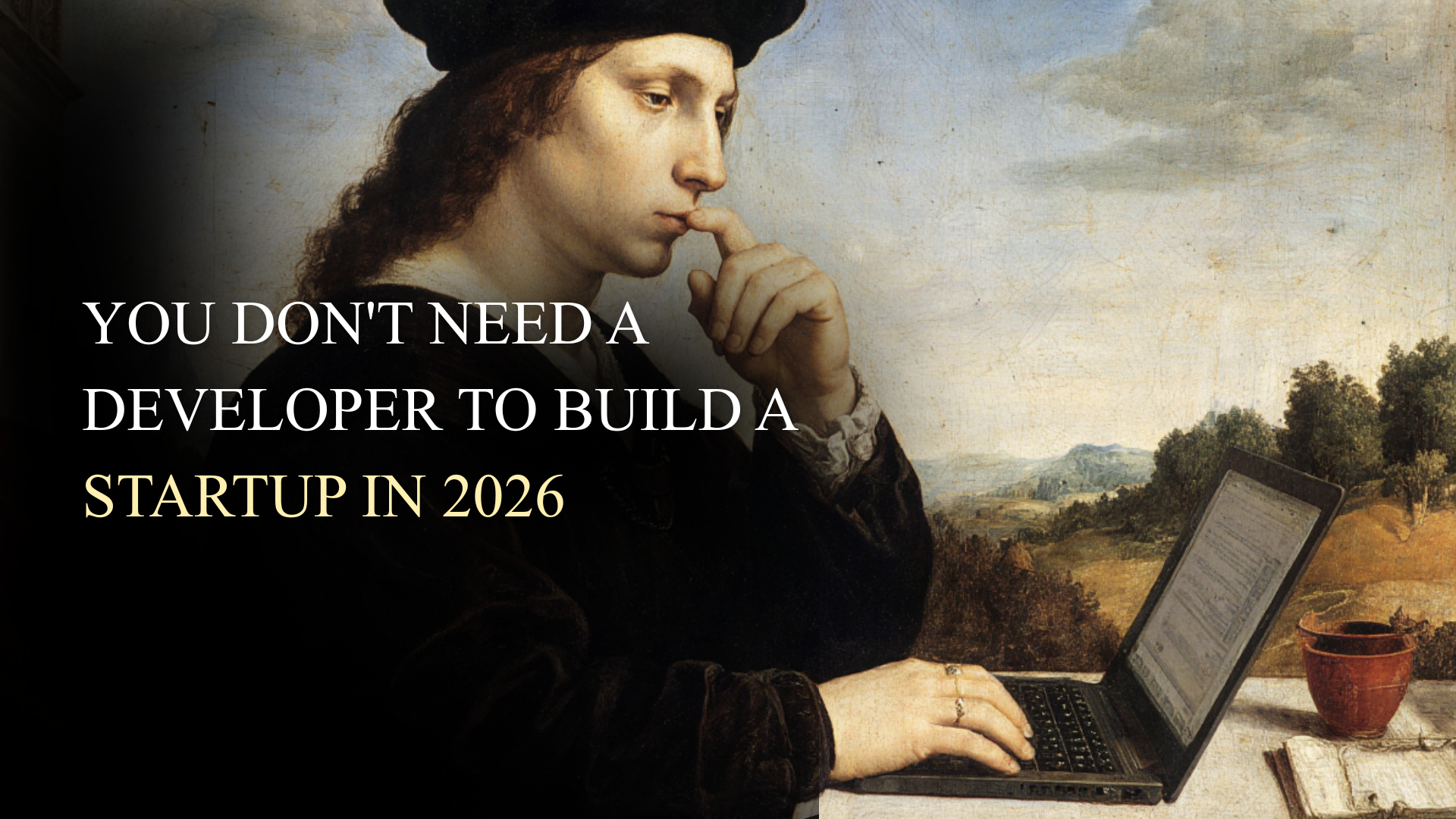
You Don't Need a Developer to Build a Startup in 2026. Here's Why.
For decades, the rule was simple: no developer, no product. If you had an idea but couldn't code, your only options were expensive, slow, and risky — hire a developer, find a technical co-founder, or spend a year learning to code yourself.
That rule is broken now. Here's what changed, and how realistic it really is to build without a developer today.
Why It Was Impossible Before
- Software required specialized language. Building a product meant writing code line by line, in languages that took years to learn properly.
- Every feature needed a developer's time. Even small changes — a new button, a different flow — had to go through someone who could code.
- Technical co-founders were the gatekeepers. Non-technical founders were often told to "find a CTO" before they could even start.
- Cost was the biggest barrier. Hiring developers or agencies meant tens of thousands of dollars before you had any proof the idea worked.
Why It's Possible Now
Three things changed at the same time:
- AI can write and ship working software from plain-English instructions. Tools like Claude Code can build entire applications from a conversation, not a codebase you write yourself (Theanna, 2026).
- No-code and low-code went mainstream. Gartner projected that 70% of new applications would use no-code or low-code technology by 2025 — meaning most software being built today doesn't start with someone typing code from scratch (Theanna, 2026).
- AI is now standard startup infrastructure, not a bonus. A Techstars survey found that 74% of entrepreneurs already use AI as a core part of how their startup runs (HubSpot, 2026).
The result: the work of "translating an idea into software" — which used to require a developer — can now be done directly by the founder.
How Realistic Is This, Really?
The data says: very realistic, and it's already happening at scale.
- In Supabase's State of Startups 2026 survey, 40% of builders now have more than three-quarters of their code AI-generated — and among non-technical founders specifically, that number rises to 54% (Supabase, 2026).
- Founders who lean into AI report that building the product is no longer the hard part — selling it still is. As one respondent put it, AI has taken over the routine coding work, freeing people to focus on design, strategy, and customers (Supabase, 2026).
- Non-technical founders like Nomiki Petrolla have publicly documented building their entire product — marketing site, SEO, and app — through conversations with AI, with no development team involved (Theanna, 2026).
What This Doesn't Mean
To be clear-eyed, not naive:
- "No developer" doesn't mean "no skill required." You still need to think clearly about the problem, the user, and what "done" actually looks like. Vague instructions produce vague products.
- A working prototype isn't the same as a scalable business. AI-built products can look polished fast and still break under real usage if nobody with experience reviews the architecture and security.
- This is where the founder's judgment — or the right advisor — still matters most. The gap between a demo and a durable product is exactly where guidance pays for itself.
The Bottom Line
The barrier used to be technical. In 2026, it's strategic. The founders who win aren't the ones who can code — they're the ones who can think clearly about their product and know how to direct AI to build it well.
That's the shift Santal Consulting works inside: helping founders and established businesses use AI as real infrastructure, not a novelty — so the idea, not the missing developer, is what decides whether the startup happens.
Sources: Supabase State of Startups 2026 · HubSpot AI Statistics for Startups · Theanna: AI Tools for Non-Technical Founders 2026 · Theanna: Non-Technical Founder Guide